Saturday, April 07, 2012

Cost of laptops fall down from $200 To $35

Children are our future and our legacy and deserve all the support we can give them. Creativity and experience of people could be increased, if they are exposed in diverse field during childhood. Unfortunately, Nepal being an under developed country, she is not able to give opportunity to every children to expose towards education and technology.  However, we hope. In an evermore technological world, however, are we equipping our children to be passive users or do we understand the importance of empowering them to do more than simply download songs and videos created by other faraway peoples?

The "One Laptop Per Child" project
One Laptop Per Child's mission statement runs as follows:

  • To create educational opportunities for the world's poorest children by providing each child with a rugged, low-cost, low-power, connected laptop with content and software designed for collaborative, joyful, self-empowered learning. When children have access to this type of tool they get engaged in their own education. They learn, share, create, and collaborate. They become connected to each other, to the world and to a brighter future.
Few people would care to disagree with any of the above.

In 2010, the One Laptop Per Child project was selling its computers for around $200. In collaboration with governments in developing countries across the globe, by 2011 1.84 million units had been shipped to precisely the children the mission statement was aimed at. Originally, however, this computer was intended to sell at $100. The rising costs of projects such as these are sometimes unavoidable. In this case, unhappily, as the data here demonstrates, sales have not been as buoyant as they could have been.

Aakash Ubislate Tablet PC
A potentially strong competitor, at least on virtual paper, looked as if it might be the “Made in India” Aakash Ubislate tablet. Priced around $62, its price advantage against the OLPC laptop was clear, with the price dropping to $50 for institutions which received the tablet via government initiatives. As with many cheap alternatives to the iPads and PCs of this world, there were advantages and disadvantages to this product which made it hard to evaluate one way or the other.
Advantages: Portability, Cheap, Expansion and connectivity
Disadvantages: Poor screen, Poor battery, No Android Market
There is one thing which must be said in its favour, however: its order books have been extremely healthy. The upgraded Ubislate7+ version, which has rapidly served to apply the user experience of the earlier model, has already generated over two million pre-orders since it was put on the market at the beginning of 2012.

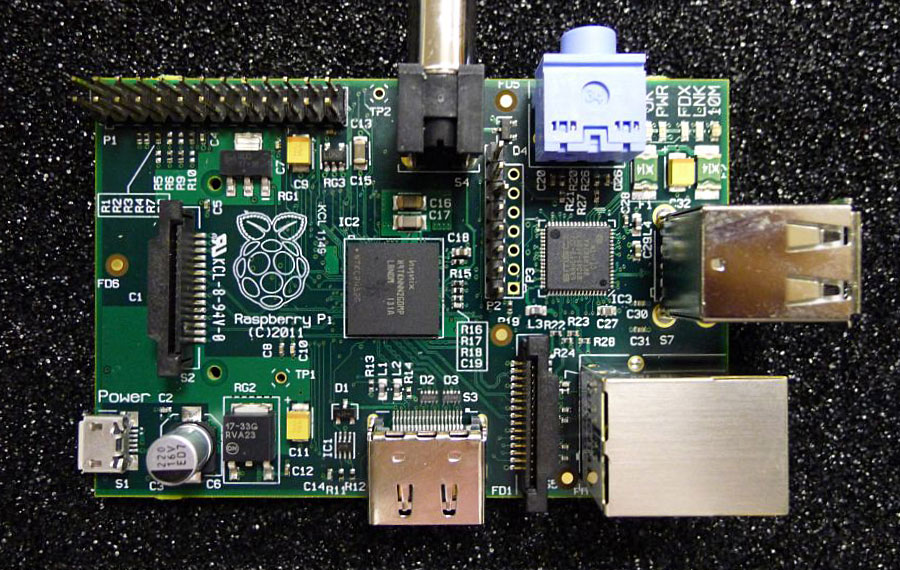
What about the Raspberry Pi ?  (Picture)
Contrast the above experiences, then, with this year's other massive computing sensation: the Raspberry Pi. It is said there have been over “2 million expressions of interest or pre-orders” since the product was launched on 29th February 2012. Far more significantly, this single-board computer – without a case or even an onboard clock, and which runs Linux on an ARM processor – costs less than $35. Aimed at teaching schoolchildren how to program and generally get their hands dirty by playing around with the inside of the hardware in question, it follows a recent British government report which concluded that children spent far too much time being taught how to use software as relatively passive end-users and not enough time learning how to be creative with information technologies.
It is, of course, early days – but, with such computing projects, we may soon be seeing our young people designing websites and technologies for areas of business ranging from cash isa transfer sites to new and novel kinds of online communities.

Does the future of computing really lie in the palm of one's hand?
Many people have been arguing over the past few years that the future of computing is mobile. Cory Doctorow recently made an impassioned plea, however, on behalf of computing technologies and mindsets which allowed people to continue to act as cyber-mechanics, as they proceeded to want to open up and fiddle around inside the boxes of their machines.

From the locked-down but unlockable versions of the OLPC laptop to the caseless and totally open Raspberry Pi of recent months, via the Ubislate tablet of cut-down yet apparently marketable compromises, it's clear that the key to cheap computing has no one-size-fits-all solution. If we had to side with Doctorow, though, it's surely the Raspberry Pi and its fellow competitors we'd be supporting.
Our children do, after all, deserve the very best. The very best isn't a closed piece of kit which you can't even unscrew but something which allows them to change the world around them and interact with its marvels and glories.

That's what kids do.
That's what we should allow them to do like Mahabir Pun did a lot for rural people and fecilated them to access computer and internet.

Friday, March 30, 2012

Development Version of Mendeley 1.5 is Available

Mendeley is one of the popular and easy reference managing software. It can be installed in Windows, Linux and Mac OS. Combination of Mendeley with Zotero, another reference managing add-on of Firefox, could be very effective to run. Although it is one of the best for Linux OS, but it still has some limitations like abbreviation of journal's name, writing first capital letter for each word of name of journal, etc. are still limiting factors (or at least I assume). I hope, these limitation will be addressed in final stable release of this latest version. Please visit here to download and don't forget to back up Mendeley library.

Wednesday, March 28, 2012

What happens when he meets a fey?

When he meets a fey
Unlike other, he can’t say hey

This beautiful creation
Only on his imagination

Others feel and whistle
Excite and become drone
But he needs to be grown
Or does he have the Freudian syndrome?

Sunday, February 19, 2012

Finally, we got Publication in International Journal

After a long waiting, between frustration and enthusiasm, we read enthusiastic and pleasant news about the acceptance of our article in international journal. And surprisingly, it is included in top five "highly accessed" articles for this month (February, 2012).

We had spent almost two years in this research including literature search and writing time. Kathmandu Model Hospital and Central Department of Microbiology had provided lab facility.  Although we had not got any kind of stipend and financial support and even no internet facility in lab or university (it was not free), we did it.  We used to visit Cyber café @ Rs. 20-40 /hour for literature search and related articles. The co-authors, Pankaj Baral and Sanjiv Neupane had spent their pocket money to purchase chemicals such as DNA ladder, restriction enzymes, etc. I spend pocket money for collection of various medicinal plants and some medicines (in kg) that we are using traditionally. Some of our relatives and colleagues used to laugh at us and say it was craziness. This had created a bit disappointment, but we had the enthusiasm for science and research. These days, scientists from most of the developed countries are demanding from Government not to cut the budget for Science and Technology, where as we are struggling for a fraction of amount the budget for Science and Technology.

We would like to thank and express a heartful gratitude to Prof. Dr. Ronald Bauerele, Virginia University School of Medicine, USA, who trained us about the technique of Molecular Biology during six months stay in Nepal. Also, he provided technical and moral support along with science discussion. Thanks to Prof. Dr. Anjana Singh, Central Department of Microbiology, Dr. Bharat Pradhan, Kathmandu Model Hospital and obviously our mentors for guidance and for the arrangement of laboratory.

Saturday, December 31, 2011

To Uplift Science, Nepal Needs him who Published An Obituary in Nature (Journal)

Recently, Prof. Dr. Uttam Lal RajBhandary has published an obituary [1] of Har Gobind Khorana in Nature, one of the most reputed and famous science journals. Har Gobind Khorana (HGK), Nobel Laureate, chemical biologist, was born in Raipur, Punjab, Pakistan (then India) passed away on 9th November 2011. He, along with Marshall Nirenberg, Heinrich J. Matthaei, and Robert W. Holley, had discovered sequences of RNA (UUU, UGA, AUG…… codons) that code for amino acid synthesis and they received the Nobel Prize in 1968.  Prof. UL RajBhandary, Department of Biology, MIT, USA, has been in close association with him since 1962. Quoting HGK’s statement Prof. UL RajBhandary writes, “If you want to get far, you have to travel alone.” To understand science and research, it needs very much enduring patient and deep study, and sometimes makes isolated from normal social life.  In past post of this blog, I had mentioned the name Lujendra Ojha and Deepak Koirala, Nepali bright young scientists who had published their research article in reputed journal this year.

Achievements of Prof. Dr. Uttam Lal RajBhandary / RajBhandary UL,
Scholar Google: - Citations: 9759; Cited Publications: 232; H-Index: 56
Iisiknowledge: - Times Cited: 7153; Results found: 169; H-Index: 46
Pubmed: - Articles: 187

These articles, where Prof. Dr. Uttam Lal RajBhandary is the author and all of them having impact factor above 5.0 including Nature (Impact factor is 36.1), Nature Biotechnology (Impact factor is 31.1), Cell (Impact factor is 32.4). This is a huge achievement and impressive figure, and probably it may be the highest for any Nepali and gives us happiness with the proud. Almost all scientists will to publish their findings to any one of such prestigious journals.

While I was in class 8-10, our science teacher always used to tell about Har Gobind Khorana, and his contribution to science. At the same time, in various newspapers and magazines particularly in Nava-Yuva, I could see the name of Prof. Uttam L. RajBhandary, Prof. Dayananda Bajracharya, and another few names as the successful Nepali scientist. Nava Yuva, and Yuvamanch were my favorite magazines and hardly had left any issue unread. Because, it always had included at least one article related to science and technology. USA, Russia, UK, Germany and France were frequently cited countries in those magazines. Nowadays, I rarely see the name of Russia in the journals, despite it still has been contributing to science.

Historic buildings, arts, sculptures, statutes, Ayurveda and traditional medicine, etc. are still giving proof that Nepal was leader of ancient science and architecture. For the past two centuries, Nepal has been always in a Dark Era for modern science and technology and becoming in a terrible condition. The condition is worsening day by day. In fact, it is situated almost in the bottom line in several indexes. Such a high profile scientist like Prof. Dr. Uttam Lal RajBhandary can contribute to the development of science and technology in Nepal with international collaboration. The equipment and funding are the biggest challenge for Nepal, are more important in addition to knowledge and hardworking, which we are doing (fruitlessly). Other panic part, we know our government neither knows the importance of science nor allow budget and even, I am doubtful, whether provided or not,  moral support to scientists from the government. Ministry of "science and technology" was established to make happy to some political leaders to include them in cabinet rather than to ease science and technology practitioner, what a shame for us.
However, Happy New Year 2012, Adieu 2011.

1 RajBhandary, U. (2011). Har Gobind Khorana (1922–2011) Nature, 480 (7377), 322-322 DOI: 10.1038/480322aResearchBlogging.org

Wednesday, December 07, 2011

Install OpenBabel in Fedora 16 to convert chemical file formats

OpenBabel is a software that has been widely used by computational chemist. Usually the structure of any compound are drawn using mainly ChemDraw and ACD ChemSketch  softwares and default file format are .cdx and .sk2, respectively. But for the computational study the required file format are; .mol2 or .pdb etc. OpenBabel can convert as pr required.

People who are lazy in typing may become tired in typing "babel [-i (input-type)] (name) [-o (output-type)] (name)" many times to convert the individual files. They may seek to install the graphical version of OpenBabel by the command "cmake ./openbabel-2.x.x -DBUILD_GUI=ON" but thay may face a lot of difficulties in many Linux Distros such as to install wxWidget.

As I have been mentioning Fedora, a kind of Linux operating, is the leader NOT a follower, many latest Linux software repository can be acquired easily in Fedora through yum. Similarly it is very easy to install OpenBabel in Fedora 15 and 16.

  1. Become root by typing su and then your root password.
  2. Type yum install openbabel-gui
  3. wait and then press y.
It will be installed within 10-15 minutes and enjoy.

Monday, November 14, 2011

PhD opportunity for Nepalese

We are lacking of equipment, funds, opportunity, and the policy makers who had never try to understand the value of science so that we have no reputation despite our honesty and laborious work. But we have strong theoretical background in TU and other Universities of Nepal due to tough syllabi/syllabuses  and competition. Erasmus Mundus Europe Asia (EMEA) scholarship has given high priority for Nepalese, and offering full-funded MS, PhD and post-doc positions in different universities of Europe. Nepali passport bearer who completed MSc or 4-year BSc are eligible to apply. Probably, stipend will be 1000-1600 Euro/month. Dead line is December 1, 2011. Click here for more information, also visit about TWAS scholarships.

Wednesday, November 09, 2011

Update Mendeley, Reference Managing Software

Due to different styles of references for thesis or articles to be submitted in different journals or departments, reference managing software is exigent nowadays. Mendeley is a freely available reference managing software, which is the most suitable for Linux user, however, Windows user can also use it. Endnote is another good option for Windows user but we have to pay for license.
        Full version of Mendeley 1.1.3 was released few months ago, download from here.

  1. Extract to your suitable folder e.g., to /media/sda5/softwares
  2. Run by clicking icon "mendeleydesktop" on the location of /media/sda5/softwares/mendeleydesktop-1.1.3-linux-i486/bin
  3. Go to "tools" and "Install OpenOffice Plugin" or "Install LibreOffice Plugin" (if you see the message "it won't find "unopkg" in its default location...................... or something like this" then, locate towards /opt/libreoffice/program and click "unopkg" )
  4. Click on "Add Documents" and locate any one PDF and add
  5. Open "LibreOffice Writer" or "OpenOfficeOrg writer" (equivalent of MS Word) and write something
  6. Click "Insert Citation" then go to Mendeley Desktop and click the PDF in the document section just you have added (BibTex or other format can be added)
  7. Click "send citation to word processor"
  8. Then go to word file and click "insert bibliography"
Enjoy
you can choose different citation styles according to your requirements.

Friday, October 21, 2011

Arthritis (बातज्वर), Molecular Mechanism of Pathogenesis

Please wait for few seconds in case of slow internet.
View my previous abstract post on Pathogenesis of Arthritis

Tuesday, October 11, 2011

Cannot Nobel prize be awarded for Windows OS, Google or Facebook ?

Announcement of Nobel prize soothed pounding of many people. Although no Nepali has been awarded, Nobel prize is the subject in the gossip of literate Nepali. Nobel prize has been becoming the dream and destination not only for scientists but also for politicians, economists, writers and so on. Nobel prize is intended for new discovery, or significant contributor who made life easier and well organized society.

The first step in the discovery of theory or science is the designing of research through literature search. Some search engines certainly have signified and accelerated in this process. There are many search engines, and Google is the widely used and popular. Google search engine script was discovered by Larry Page and Sergey Brin as PhD candidates at Stanford University. 

Analysis and data interpretation of research and experiments needs software for promptness and accuracy. The software needs good platform to be installed. Bill Gates and his colleagues had discovered and developed the popular operating system (OS), DOS, Windows. Mac OS, Unix, Linux, FreeBSD, etc. are the other OS, but still they  are not as popular, and easier as Windows OS. In addition, Microsoft has developed the office packages (Word, Excel, PowerPoint, etc.), which are also essential in research. Nobel prize in Physics has been awarded for research of hard disk miniaturization (2007), and development of integrated circuits (2000), which are essential part of computer hardware. I think, Software developer also has the similar type of contribution and deserves for the Nobel prize. 

Facebook and twitter, however, are not essential in the scientific study, but they are popular among the community and  are good medium to increase the relationship and information. And Facebook is the top web page based on the number of users everyday.

In my opinion, the famous novel, Harry Porter, Miscrosoft OS, Google, Facebook, Twitter, or their designer deserve Nobel prize in literature. Probably, there would be a policy, not to award Nobel prize who had gained popularity and money.

If Nobel prize is awarded for these computer applications, which category would be appropriate for them? Physics, due to the scripts design and engineering? Economics, as these are among top revenue generating companies? Peace,  because Facebook and Twitter had played an important role to dethrone the tyrant of Egypt and other countries. some people may think reverse of it, people agitated and involved in violence due to Facebook and Twitter.

Friday, September 30, 2011

Medicinal Plants in Nepal, Acorus calamus (बोझो)

Since antiquity, man kind has been using plants to treat many diseases and some of these traditional medicines are still included as part of the habitual treatment of various maladies. Nepal also has been relying on locally available medicinal plants and in some remote area of Nepal, still there is few option for modern allopathic treatment. I am posting in serial, some of these important medicinal plants that are frequently used.

Acorus calamus L. (English: Sweet flag; Nepali: बोझो)
It belongs to the family Araceae. It is an erect herb with aromatic rootstock, leaves broad, ensiform, with distinct midrib. Spathe cylindrical and slightly curved. Flowers: bisexual, each with a perianth of six orbicular concave segments, stamens 6, ovary conical, fruits: oblong berries.
Constituents: Monoterpene hydrocarbons, sequestrine ketones, asarone (2, 4, 5-trimethoxy-1-propenylbenzene), and β-asarone contained in the essential oil distillates from root .
Uses: It is used as an analgesic for the relief of toothache or headache, to cure /prevent a hangover, to treat a cough, as a carminative for colic, to treat diabetes, to reduce bowel pains, to lessen swelling and for constipation, to cure fevers, for asthma and bronchitis, and as sedative. It exhibited a good anti-fungal activity as well.
References:

  1. Joshi KK and SD Joshi. Genetic Heritage of Medicinal and Aromatic Plants of Nepal Himalayas. Buddha Academic Publishers and Distributors Pvt. Ltd., Kathmandu, Nepal. P-239 (2001).
  2. Bajracharya MB. Ayurvedic Medicinal Plants and General Treatment. Piyusavarsi Ausadhalaya Mahaboudha, Kathmandu, Nepal. P-230 (1979).
  3. Devkota KP, R Acharya, MP Baral and RP Adhikari.  Antimicrobial activities of some herbal plants used in traditional medicine in Nepal. In: Proceding of 3rd national conference on science and technology. Vol 2: 1311-1317. (1999).
contd....

Friday, September 23, 2011

महिलाहरुमा autoimmune रोगको सम्भावना ज्यादा हुने कारण

चालिस बर्ष उमेरपछिको स्थिती हेर्ने हो भने, पुरुषलाई भन्दा महिलालाई auto-immune रोग लाग्ने सम्भावना तीन गुणा धेरै हुन्छ । अहिले सम्म पाइएको तथ्याङ्क अनुसार, महिला : पुरुष = ३:१ छ । मेरो लेख, Auto-immune रोग के हो त ? हालसालै गरिएको अध्य्यन अनुसार महिलाहरुमा auto-immune रोगको सम्भावना ज्यादा हुने निम्न कारणहरु पत्ता लागेका छन् ।

  1. Estrogens (oestrogens) हार्मोन महिलाहरुमा उत्पादन हुन्छ भने पुरुषहरुमा testosterone हार्मोन । estrogens हार्मोनले immune system ज्यादा सकृय हुन उत्प्रेरणा दिन्छ ।
  2. मानव शरीरमा २३ जोडा अनुबशिंक तत्वहरु (chromosomes) हुन्छन् । प्रत्येक जोडामा एक-बाबु तथा एक-आमाबाट आएका हुन्छन् । पुरुष र महिलामा २२ जोडा chromosome एकै किसिमका हुने भएता पनि २३ औं जोडा भने फरक हुन्छ । २३ औं जोडामा XX (महिला), XY (पुरुष)हुन्छ । यहीँ X chromosme मा immune प्रणालीलाई ज्यादा सकृय बनाउने केही रसायनहरु उत्पादन गर्ने अनुबशिंक तत्वका ईकाइहरु (genes) रहेका हुन्छन् । महिलाहरुमा X-chrosome दुइवटा हुनाले पुरुषको तुलनामा यस्ता रसायन हरु पनि दुईगुणा बढी उत्पादन हुन्छन् । हुन त gene दुईगुणा भयो भन्दैमा त्यसको उत्पादन पनि अनावश्यक रुपमा दुईगुणा नै हुन्छ भन्ने त होइन । नचाहिएको एउटा gene लाई छोपेर राख्ने र यस्को उत्पदन हुन नदिने अर्कै प्रणाली हुन्छ, यदी यो प्रणाली बेकार भएमा मात्र महिलाहरुमा autoimmune रोगको सम्भावना ज्यादा हुन्छ।
  3. Microchimerism:- गर्भावस्थामा रहेको भ्रुण/बच्चा महिलाको रक्तसंचार प्रणाली सँग प्रत्यक्ष सम्पर्कमा रहेको हुँदैन, साल-नाल को माध्यमबाट अप्रत्यक्ष रुपमा संपर्कमा रहेको हुन्छ । तर, कारणबस महिलाको रक्तसंचार प्रणालीमा बच्चाको कोष, तन्तु इत्यादी आउन पुग्यो भने महिलाको Immune system सकृय भाईहाल्छ । यो सकृयता Helper CD4 T-cell ले स्मरण गरिराखेको हुन्छ जसले महिलालाई बच्चाको जन्म पश्चात पनि हानी पुर्याउँछ । सामान्यत: बच्चाको जन्म पश्चात यस्ता Helper CD4 T-cell आँफैँ नस्ट हुन्छन् ।