Showing posts with label Article. Show all posts

Saturday, November 07, 2015

Active Nepalese Blogger and Future of Blogging

There were hundreds of Nepalese blogger writing in Nepali and English from Nepal and abroad. Despite many hurdles, political imbalances, difficulty in internet and electricity access; many of them were frequently feeding us. However, the majority of them disappear from blogverse (Universe of blog), nowadays. Mainly due to Facebook and Twitter, which are proving platforms for mini and micro-blogging, several online newspapers, and may be due to chaos in the country.

Country is suffering from unannounced blockade making distasteful festivals and life. We are struggling to get minimum living things such as gas for cooking, vehicles, even medicines, just a few to mention here. We have to spend majority of time to get such minimum living standard impeding for other creativity. However, still some blogger are paying more attention to the aesthetic value of blog for Nepalese and promulgating voluntarily. According to contribution since past month, the following are active blogs for the Nepalese by Nepalese.  News blog, copy-paste blog, the blog which are filled only with personal bio-data, and malfunctioned or virus infected blogs are removed from the list. Please, suggest me if remains to be included.


1. साहित्य संग्रहालय
2. मेरो संसार
3. केही आफ्नै कथा, ब्यथा अनि भावनाहरु
4. समय र परिवेश
5. नेपालप्लस
6. सापेक्ष बुझाई
7. रामकुमार परियार
8. Sarad Kumar Gauchan's DIARY
9. Nepalvidhya
10. Tales of Sun and Rain (घामपानीका कहानी)
11. hataru/हटारु
12. Apawad
13. अनलाइन कम्प्युटर इनिस्टीच्युट
14. अभिनव.कम 
15. गाउँले मन
16. मेरो चौतारी डट कम
17. DAUTARI :: दौंतरी
18. शब्द (Shabda) ...
19. SCIENCE TO SOCIETY
20. Aakar Post
21. Bikash Koirala | What I Feel
22. मेरो खेस्रा whatever i feel 
23. Palpali Milan
24. मेरो आफ्नै सेरोफेरो
25. शब्द चित्र डट कम
26. शहरबाट शब्दहरु
27. साहित्यः जीवनको निम्ति
28. मेरो ब्लग
29. समकालीन साहित्य
30. Rabindra Neupane
31. यात्रीको ब्लग
32. merokalam.com
33. प्रगतिशील लेखक सङ्घ, नेपाल
34. Kapilvastu Day Blog

Notable blogs, which were active in the past, are here. Hopefully, these will be reactivated again.
मेरो विचार र अभिव्यक्तिको साझा चौतारी
क्यामज्जा
☽कृष्णपक्ष☆
दूर्जेय चेतना
साइबर चौतारी
Because of gradual loss of enthusiasm in blogging and many hurdles in Nepal, blogverse may shrink in future, however, it gives immense self-satisfaction.

Friday, August 17, 2012

5 Things We Might Not Know About Our Universe

The universe is an awfully big and mysterious place. Humans have been working to pick apart it's intricacies for thousands of years now, and we are only just beginning to understand some of the more basic pieces of the galactic puzzle. It seems that with every new piece of knowledge that we gain, we open up a number of new questions for research. The following is a list of 5 things that we still might not know about our universe.
1. How did the universe begin?
 There are a number of theories ranging from the big bang all the way to the idea that a supreme being built the universe from a vast blank. Although many theories have emerged, there is no definitive answer to the question of how the universe began. Scientists are developing powerful telescopes in an effort to effectively see in to the past for clues that can answer this question.
2. What is dark matter and dark energy?
Our universe is made up of roughly 95% dark matter and dark energy. What this means is that the matter that we, as humans, can see, touch, smell, et cetera, is largely the minority of matter and energy in the universe. Dark matter and energy is being researched from a multitude of angles. There are no definitive answers to any of our questions regarding this phenomenon.
3. Will the universe ever slow it's expansion?
The universe is proven to be expanding away from itself at a high velocity. Scientists say that the speed is still increasing. What this means for humanity is completely unknown. We may never have the time to get a grasp on this knowledge.
4. Is there more than one universe?
This question is presented by renowned physicist, Stephen Hawking. He hypothesizes that, like galaxies, there are an indeterminate amount of universes which make up an even larger multi-verse. This theory can only be proven when we can develop more powerful telescopes.
5. Is there life somewhere out there?
This is possibly the most compelling of the unknowns. Are we alone? Are there other intelligent life forms somewhere out in the stars wondering on the same existential questions that we sit here pondering? We can only hope that we will find ways to sustain our race for long enough to find the answers to these ultimate questions of the universe.

This is a Guest Blog Post written by Kathleen Hubert. Check out more of her work at hawaiivacations.org.

Saturday, December 31, 2011

To Uplift Science, Nepal Needs him who Published An Obituary in Nature (Journal)

Recently, Prof. Dr. Uttam Lal RajBhandary has published an obituary [1] of Har Gobind Khorana in Nature, one of the most reputed and famous science journals. Har Gobind Khorana (HGK), Nobel Laureate, chemical biologist, was born in Raipur, Punjab, Pakistan (then India) passed away on 9th November 2011. He, along with Marshall Nirenberg, Heinrich J. Matthaei, and Robert W. Holley, had discovered sequences of RNA (UUU, UGA, AUG…… codons) that code for amino acid synthesis and they received the Nobel Prize in 1968.  Prof. UL RajBhandary, Department of Biology, MIT, USA, has been in close association with him since 1962. Quoting HGK’s statement Prof. UL RajBhandary writes, “If you want to get far, you have to travel alone.” To understand science and research, it needs very much enduring patient and deep study, and sometimes makes isolated from normal social life.  In past post of this blog, I had mentioned the name Lujendra Ojha and Deepak Koirala, Nepali bright young scientists who had published their research article in reputed journal this year.

Achievements of Prof. Dr. Uttam Lal RajBhandary / RajBhandary UL,
Scholar Google: - Citations: 9759; Cited Publications: 232; H-Index: 56
Iisiknowledge: - Times Cited: 7153; Results found: 169; H-Index: 46
Pubmed: - Articles: 187

These articles, where Prof. Dr. Uttam Lal RajBhandary is the author and all of them having impact factor above 5.0 including Nature (Impact factor is 36.1), Nature Biotechnology (Impact factor is 31.1), Cell (Impact factor is 32.4). This is a huge achievement and impressive figure, and probably it may be the highest for any Nepali and gives us happiness with the proud. Almost all scientists will to publish their findings to any one of such prestigious journals.

While I was in class 8-10, our science teacher always used to tell about Har Gobind Khorana, and his contribution to science. At the same time, in various newspapers and magazines particularly in Nava-Yuva, I could see the name of Prof. Uttam L. RajBhandary, Prof. Dayananda Bajracharya, and another few names as the successful Nepali scientist. Nava Yuva, and Yuvamanch were my favorite magazines and hardly had left any issue unread. Because, it always had included at least one article related to science and technology. USA, Russia, UK, Germany and France were frequently cited countries in those magazines. Nowadays, I rarely see the name of Russia in the journals, despite it still has been contributing to science.

Historic buildings, arts, sculptures, statutes, Ayurveda and traditional medicine, etc. are still giving proof that Nepal was leader of ancient science and architecture. For the past two centuries, Nepal has been always in a Dark Era for modern science and technology and becoming in a terrible condition. The condition is worsening day by day. In fact, it is situated almost in the bottom line in several indexes. Such a high profile scientist like Prof. Dr. Uttam Lal RajBhandary can contribute to the development of science and technology in Nepal with international collaboration. The equipment and funding are the biggest challenge for Nepal, are more important in addition to knowledge and hardworking, which we are doing (fruitlessly). Other panic part, we know our government neither knows the importance of science nor allow budget and even, I am doubtful, whether provided or not,  moral support to scientists from the government. Ministry of "science and technology" was established to make happy to some political leaders to include them in cabinet rather than to ease science and technology practitioner, what a shame for us.
However, Happy New Year 2012, Adieu 2011.

1 RajBhandary, U. (2011). Har Gobind Khorana (1922–2011) Nature, 480 (7377), 322-322 DOI: 10.1038/480322aResearchBlogging.org

Tuesday, October 11, 2011

Cannot Nobel prize be awarded for Windows OS, Google or Facebook ?

Announcement of Nobel prize soothed pounding of many people. Although no Nepali has been awarded, Nobel prize is the subject in the gossip of literate Nepali. Nobel prize has been becoming the dream and destination not only for scientists but also for politicians, economists, writers and so on. Nobel prize is intended for new discovery, or significant contributor who made life easier and well organized society.

The first step in the discovery of theory or science is the designing of research through literature search. Some search engines certainly have signified and accelerated in this process. There are many search engines, and Google is the widely used and popular. Google search engine script was discovered by Larry Page and Sergey Brin as PhD candidates at Stanford University. 

Analysis and data interpretation of research and experiments needs software for promptness and accuracy. The software needs good platform to be installed. Bill Gates and his colleagues had discovered and developed the popular operating system (OS), DOS, Windows. Mac OS, Unix, Linux, FreeBSD, etc. are the other OS, but still they  are not as popular, and easier as Windows OS. In addition, Microsoft has developed the office packages (Word, Excel, PowerPoint, etc.), which are also essential in research. Nobel prize in Physics has been awarded for research of hard disk miniaturization (2007), and development of integrated circuits (2000), which are essential part of computer hardware. I think, Software developer also has the similar type of contribution and deserves for the Nobel prize. 

Facebook and twitter, however, are not essential in the scientific study, but they are popular among the community and  are good medium to increase the relationship and information. And Facebook is the top web page based on the number of users everyday.

In my opinion, the famous novel, Harry Porter, Miscrosoft OS, Google, Facebook, Twitter, or their designer deserve Nobel prize in literature. Probably, there would be a policy, not to award Nobel prize who had gained popularity and money.

If Nobel prize is awarded for these computer applications, which category would be appropriate for them? Physics, due to the scripts design and engineering? Economics, as these are among top revenue generating companies? Peace,  because Facebook and Twitter had played an important role to dethrone the tyrant of Egypt and other countries. some people may think reverse of it, people agitated and involved in violence due to Facebook and Twitter.

Thursday, June 23, 2011

Epidemics of Diarrhea due to Escherichia coli (Shiga toxin producing enterohemorrhagic) in Europe

Recently, enterohemorrhagic Escherichia coli (EHEC) strain has infected over 3,500 and kills over 40 people in the Europe and most of them are German [1]. Initially, it was blamed to salad and vegetables and the farmers for the cause of transmission, as concluded by case-control study. But the causative bacterial strain, EHEC O104:H4 has not been found in any of these salad and vegetables samples. Then authorities realize farmers were not culpable. Then they withdraw the blame with apology and announce the compensation for farmers. Now suspecting on bean, sprout, and agricultural practice [2].

EHEC O104:H4 is a type of E. coli classified on the basis of somatic O-antigen (over 170 different type: 1-170), and flagellar H-antigen (over 50 different types: 1-50). In E. coli, there are different chemical structure and functional group comprising lipopolysaccharide of plasma membrane (O-antigen), polysaccharide of  capsule (K-antigen) and flagella (H-antigen). Combining of these different antigens there could be thousands of different types of E. coli. The infective EHEC O104:H4 is new to Europe but this strain was reported from Korea in 2006 [3]. Does this means this strain is shipped from Korea? Certainly not, or needs exigent research.

Every organism has the tendency to adapt the environment with necessary genotype reshuffle or addition, and phenotypic variation, suitable to survive, as Darwinism. Bacterial strains also, always tend to increase virulence and pathogenicity by adapted gene transfer and mutation. In latent type of infection, plasmid and/or gene transferred from virulent strain to non-virulent may get proliferated for several months without symptom and unknown to health professional. This may be the one of the possible reason for outbreak in Europe, which is still under research to find the source of infection. So, the organism whose reservoir is the environment, they proliferated when the environmental condition becomes optimum, as said by Rita Colwell [6].

Vibrio, Escherichia has the environmental reservoir unlike smallpox and polio virus. So they are always prone to infect mammal once environmental condition become favourable. E. coli is even more dangerous as it is opportunistic pathogen and can acquire antibiotic resistance as well as virulence.

In my study (in NAST), some strains of E. coli were found to be resistant against all commonly used antibiotics (courtesy: Nabaraj Dahal, Pankaj Baral, and Sanjiv Neupane). This shows it is the dreadful strain having most flexibility in genetic variation among bacterial kingdom. However, the innovation and more research on antibiotics may enervates its massive proliferation.
Multi-drug resistant E. coli reconfirmed on M-endo agar.
Antibiotics sensitive E. coli (ATCC 25922) reconfirmed on M-endo agar.
Even in the Europe, the bacterial strain can invade people where living standard is high as well as good sanitation, well managed health system. Also, Nepal had faced problem of diarrhoeal epidemics and hundreds of people died in remote area, two years ago. But it was different scenario, poor people were lack of medicine and ORS.
Few months ago, an unprecedented outbreak of cholera in Haiti was the reason to blame Nepalese peacekeeping soldier. But neither stool nor rectal swab nor antibody test of these soldiers showed positive result of V. cholera (or was not investigated). Even no one could be verified as carrier. And probably, the sample of drinking water, seawater and sewage from different source was not analysed properly to make a conclusion. Only the co-incidence was the bacterial strain found there resembled with the South Asian strain, which is not only confined in Nepal but also other South Asian countries like Bangladesh, India, Pakistan etc.

References:
  1. European Centre for Disease Prevention and Control,  Stockholm, Sweden, 22 June 2011, 11:00
  2. Editorials, 16 June, 2011, Nature, Vol. 474, 251
  3. Woo Kyun Bae, et al., Jun 2006, Yonsei Medical Journal, Vol. 47(3), 437-439
  4. Marian Turner,  9 June, 2011, Nature, Vol. 474, 137
  5. Kai Kupferschmidt, 10 June 2011, Science, Vol. 332, 1249-1250
  6. Martin Enserink, 5 November 2010, Science, Vol. 330, 738-739

Sunday, April 17, 2011

Cholera in Haiti and Association to South Asia and Scientific Study to Reduce Recurrence

In the fall of last year, unprecedented outbreaks and epidemics of cholera in Haiti agitated locals, news media, health workers. There has been a long debate about these epidemics. The situation has been highlighted by famous science journals and has come to my attention.

Although the cholera outbreak had been diminishing, and the overall fatality rate was down to 2 % from earlier 9%, and 4,550 deaths and 231,070 cases were reported, still there were few cases, as United Nations, Geneva said at the beginning of February. The serotype of the causative agent, Vibrio cholerae, has been identified that resembles with South Asian strain. The mortality rate of untreated cholera is 50-60% (one of the highest mortality rates).

Transmission
Vibrio cholerae is transmitted to humans via the fecal-oral route via water or food. The reservoir of the organism is suspected of the aquatic environment. In its extreme manifestation, cholera is one of the most rapidly fatal illnesses known.

Clinical Symptoms
Cholera begins with the sudden onset of massive diarrhea, excretion of protein-free fluid and associated electrolytes, bicarbonates, and ions within a day or two. This loss of fluid leads to dehydration, anuria, acidosis, and shock. The watery diarrhea is speckled with flakes of mucus and epithelial cells ("rice-water stool") and contains enormous numbers of vibrios. The loss of potassium ions may result in cardiac complications and circulatory failure.

(Technical Terms Starts)
"Vibrio cholerae , Morphology and Culture
It is a Gram-negative non-sporing, non-capsulated, curved rod, motile, monotrichous (single polar flagellum), oxidase-positive (distinguished from enteric), glucose fermenter, non-lactose fermenter bacterium. Widely used enrichment mediums for this bacterium are; alkaline peptone water (APW), Cary-Blair transport medium, etc. And the common selective media for the isolation are; alkaline bile salt agar (BSA) medium (colonies are very similar to those on nutrient agar), Monsur's gelatin Tauro cholate trypticase tellurite agar (GTTA) medium (small translucent colonies with a grayish-black center), Thiosulpbate citrate bile salt (TCBS) agar medium (yellow nucleated colonies), polymyxin-mannose-tellurite (PMT) agar medium (differentiate between V. cholerae O1 from V. cholerae non-O1 based on mannose-fermentation), etc.

Disease Mechanism
V. cholerae start to produce the toxic proteins (cholera toxin, CTX / CT) only after reaching the intestine. It is an oligomeric complex made up of six subunits: one (A subunit), and five (B subunit). The B subunits bind to GM1 gangliosides on the intestinal epithelium cells. So the protein enters the cell via receptor-mediated endocytosis. Then the A1 subunit becomes free and binds with ADP-ribosylation factor 6 (Arf6), which permanently ribosylate the Gs alpha subunit of the heterotrimeric G protein. This results in constitutive cAMP production and pumps out Cl, HCO3−, etc., into the lumen of the small intestine which prevents sodium ions from entering the cell, and these ions create a salt-water environment, which through osmosis can pull up to 6 L of water per day through the intestinal cells, creating the massive amounts of diarrhea, and rapid dehydration.  Virulent strains of V. cholerae is due to temperate bacteriophage called CTXf or CTXφ. V. cholerae is well adapted and can, economically, produce different proteins in the different environments e.g., in the intestine, TcpP/TcpH proteins, which, together with the ToxR/ToxS proteins, activate the expression of the ToxT regulatory protein. ToxT then directly activates expression of cholera toxins, and allowing the bacteria to colonize the intestine."(Technical Terms Finished)

Risk Factors
For cholera, anybody can be at risk, i.e., there is no correlation between the vulnerability of infection and age, gender, malnutrition status, etc. It is one of the dangerous infectious diseases that can kill healthy people quickly. After the onset of symptoms, a victim may die within 4 hours to few days if no treatment is provided. However, people whose stomach is making fewer amounts of gastric acid than normal or recently had stomach surgery, or taking drugs that inhibit gastric acid production or a person of blood type O, are at higher risk. In Peru, virtually all indigenous people have blood type O and were at higher risk.

In Nepal, May-July is the main season of cholera outbreaks.

Treatment of Cholera
Treatment involves the rapid intravenous replacement of the lost fluid and ions. Following this replacement, the administration of the isotonic maintenance solution should continue until diarrhea ceases. With this simple treatment, the mortality rate of cholera can be reduced ten-fold. A few antibiotics (e.g. tetracyclines) may shorten the duration of diarrhea and reduce fluid loss.
A few years ago, I got a chance to study V. cholerae, 01, El Tor, Ogawa biotype, while I was in NAST (former RONAST), the strain was kindly provided by Mr. Nabaraj Dahal, Patan Hospital. It was not so dangerous in terms of antibiotics resistance as compared to other strains, I investigated, such as Escherichia coli, Pseudomonas aeruginosa, Staphylococcus aureus, etc., which were almost all commonly used antibiotics resistant. Diarrhea due to enteropathogenic E. coli is more complicated than cholera, in therapy.
The problem with the management of cholera is the consumption of unhygienic food and contaminated water. Contamination problem is mainly during both dry and rainy seasons. This is significantly enhanced due to drinking water pipe, which remains together with a sewage pipe, and in some places, drinking water pipe remains inside sewage Hume pipe.
In Haiti, cholera had proliferated due to floods. Certainly, floods not only contaminate drinking water but also destroy human's habitat and obstacle the disease treatment strategy. The flood made a connection between seawater and drinking water and the possibility of flow of V. cholerae from seawater to drinking water.
There are many places in Nepal where people rely on the river, stream for drinking water, so they are always at risk of these kinds of diarrhoeal diseases. Two years ago, the death of more than 200 people due to the epidemics of diarrhea (one of the simple/neglected diseases), in the rural area of Nepal indicates inaccessibility of modern medicine, and in fact, they still have to rely on medicinal plants and rituals.
water purifier
Make pure water
water purifier in bicycle
Water purifier operated by bicycle
Recently, Singapore based water company, Glowtec has discovered a water purifying filter system, which can filter Decaliters of pure water within a minute (800 liter/hr). This can be operated by chain and the paddle of bicycle, and it can be transported anywhere as it is simple and light. It has been found very effective and significantly reduced the incidence of waterborne diseases in the flood-affected area of Pakistan, Myanmar, Yemen, Taiwan, the Philippines, and Vietnam. Vaccination is a good option to avoid cholera epidemics. Nepal, and probably all developing countries can't afford the cost and also, V. cholerae has a high mutation rate and new vaccination antigen and strategy needed within a short period for full coverage. People should keep re-hydration solutions like Jeevanjal, and should be immediately available in each home.

Acknowledgment: I thank Dr. Joachim Schindler for reviewing and some suggestions.
Picture : Quantum geoservices

References:
  1. Martin Enserink, Science, 330, 5 November 2010, p. 738-739, Haiti’s Outbreak is Latest in Cholera’s New Global Assault
  2. Martin Enserink, Science, 331, 28 January 2011, p. 388-389, Despite Sensitivities, Scientists Seek to Solve Haiti’s Cholera Riddle
  3. Declan Butler, Nature, 468, p. 483-484 (2010), Cholera tightens grip on Haiti
  4. David Cyranoski, Nature, 469, p. 273-274 (2011), Cholera vaccine plan splits experts
  5. Kalpit P., Asianews, 2009 July 23, Epidemic hits western Nepal, More than 200 dead.
  6. Katherine Harmon, ScientificAmerican, 25 October 2010, Why Is Cholera Spreading in Haiti Now?  
  7. Debora MacKenzie, NewScientist, 15 November 2010, Haiti faces years of cholera
  8. Debora MacKenzie, NewScientist, 07 December 2010, Haiti: Epidemics of denial must end
  9. Debora MacKenzie, NewScientist, 10 December 2010, Haitian cholera strain could dominate the Americas

Monday, February 28, 2011

Metarhizium anisopliae as Eco-friendly Antimalarial Biopesticide

Malaria is one of the major public health problem for Nepal, indeed all developing countries are facing the problem. Although epidemics of malaria has been reduced, emergence of drug resistant Plasmodium spp (causative agent of malaria), poor sanitation, agricultural dependency etc. still making malaria as frightening.

Living in the Terai region of Nepal was avoided due to malaria. This is the fact of just 60-70 years ago. During Rana rule in Nepal, prisoners were sent to this Terai area as punishment, where malaria was a big threat. After the discovery of anti-malarial drugs, deforestation and people's migration began and the Terai gradually overcrowded and become Nepal's dense populated area. I remember, whole houses were sprayed by DDT to get rid from the diseases transmitted by mosquito. But DDT exhibited serious environmental and public health hazards. And neither, malaria could be eliminated.

The finding (gift of science and research ?) from the University of Maryland may be helpful to combat malaria and mosquito related diseases in Eco-friendly and biological way. A fungus Metarhizium anisopliae, which is a plants symbiont protecting plants from insect, infects mosquito and some other insects and attenuates then kills. This fungus has been genetically modified (GM) and have very narrow host range e.g., only infect harmful insects. Also, this GM fungus express SM1 and scorpion proteins, toxic to Plasmodium sporozoites in mosquito that enhance the rate of killing in short time period. This fungus easily invade and infect the mosquito through the surface like if contacted to cuticle; unlike bacterial and viral infection. So, like DDT, spore of this fungus can be sprayed in bed net, house; so that it would be easily contact with mosquito and to eliminate Plasmodium spp. And, it could infect larvae of mosquito, hence meta-acid and hazardous chemicals can be replaced by the fungal spore in ditches and stagnant water pool.

However, whether this genetic engineered fungus can survive freely in environment or work significantly? Or might it create bad impact in ecology? Or will it be available easily for poor countries to use? What happens if it infect honey bee and other beneficial insects ? We have to wait.

Reference: Fang et al., Science (25 February, 2011), 331; 1074-1077

Tuesday, January 18, 2011

Presentation Styles of European/American Scientists and South Asian Scientists

I have been attending some national and international symposiums and getting chance to listen seminars by veterans from many countries. Two weeks ago, I got chance to take part in two inauguration ceremonies in a day. It was really an exciting experience as two inaugurations in a single day. Surprisingly, a distinct way of presentation styles between South Asian scientists and European/American scientists that I have realized, however, may not be interacted with sufficient eminent scientists.
South Asian
  1. The sentence starts as, I/my colleague discovered........
  2. Content : most of the literature survey, and long introduction, and few result.
  3. Slide filled with most of copied and pasted texts, and definitions.
  4. Seminar deliver : just read text that written in slide somewhat similar to reading news and make audience sleep.
  5. Spend time just to define few scientific terms.
  6. Acknowledge : no or very few.
  7. Don't care for allocated time limit.
European/American
  1. The sentence starts as, we/our team discovered........
  2. Content : most of their own result and less literature survey, and short introduction.
  3. Slide filled with most of pictorial and graphical representation of their experimental findings.
  4. Seminar deliver : describe picture or graph try to make audience understand of new discovery.
  5. Spend time using scientific terms to describe the results, science and mechanism.
  6. Acknowledge : whole team(s).
  7. Aware of time limit.
Important, this is not intended to make a conclusion that all South Asian scientists do as mentioned above, and neither all European/American scientists can always do in this manner.

Saturday, October 30, 2010

Want Expeditious and Persistent Memory? Medicate yourself and Dust off Your Musical Instruments for Child.

By Bishnu Marasini
       Except some politicians and few others who only exploit public’s emotional believes to aggrandize and become supreme. We need an urbane brain not only for deep understanding of a subject but also a wide knowledge of diverse field is essential for better life in this competitive era.
       Neuronal cells are the important component of the brain and unable to divide. Millions of the cells in our skin die and regenerate everyday. But neuronal cells once died or damaged, hardly replaced/repaired. But, upon stimulation, they can be more branched as dendrites and the secondary cells (helper of neurons) like astrocytes, oligodandrocites, microglia; ependymal cells are increased in number as well which enrich the better communication of each other increasing efficiency.
Picture 1: Musical Keyboard (Source)
       Recent study reveals the power of music to enhance the brains exhibiting increased vocabulary, multilingual capacity, reading performance and other educational activities. Pleasant waves of music not only increase volume of Grey Matter but also increases the brain’s adeptness and competence. Musical instruments work by two ways; (1) Through pleasant wave of music; (2) Curiosity/learning of instruments to produce such wave. It is most efficient at the age of 7; the stage where brain-cells are actively growing (some are increasing in volume and some in number).
       Also, flash of bright light (especially blue colored) and electric current of 1-2 mA and repeated learning of object found to be effective for long term memory.
       Although, neurons and the memory are lost with the age but the rate of deterioration can be reduced with the meditation. Neuroscientists conduct experiments upon the Buddhist Monk of NEPAL after challenged by the  (Peace) Nobel Laureate; Dalai Lama. Significant improvements were found on the Monks comparing to non-meditating people. After this exciting result, more test done on those people previously unknown of meditation, with the 20 min/day of meditation, exhibited significant improvements.
Picture 2: Preparing for Meditation (Source)
       I also used to medicate early in the morning during examination period which helped to relief from pressure of exam phobia (nowadays lazy in early rise and meditation). Nowadays, most of the elder people in Nepal are influenced by the Yoga technique of Ramdev. It will be more beneficial if some modification of Yoga for brain exercise 5-10 min/day, makes their memory long term. My personal opinion also, meditation maintains a halcyon and expeditious mind which is exigent in these morose, truculent and turbulence days.
       I don’t mean, only music and meditation are perfect for refulgent brain but these techniques adorn the regular activity of reading, writing, speaking, memory recalling, and others.

Further reading:  (1) New Scientist (2010), 2780    (2) Science (2010), 330

Friday, September 10, 2010

Switching Completely to Linux Operating System

By Bishnu Marasini 
       Although my engrossment in electronics as well as better understanding of computer hardware, I have not been working significantly in this field for 10 years (used to do at initial days). Only, as amateur technical support for my colleague is being the use and sharing of my expertise. While, parallel use of both Windows OS and Linux OS more than 10 years, I, now realized to switch completely towards Linux OS because of the following reasons.
  1. To Get rid of Virus: Windows XP is too old to resist virus attack, Windows Vista and Windows 7 also susceptible to attack, the pirated version are even worse. Linux OS might not have pulled hackers’ intention to enervate which may be due to fewer users and free/Open Source Software.
  2. Hardware Compatibility: The latest version of Microsoft like Windows Vista and Windows 7 cannot be installed or are very slow on the older CPU and Motherboard. The latest Linux OS always takes care of older CPU and motherboards but depends on the distro (type) of Linux.
  3. Better Understanding of Programming Code and Software Pleothera: Linux is free and Open Source Software and can be modified by anyone and redistribute the OS and we can read and copy every codes associated with it. This feature has been helping me to understand the meaning of code and my experiments in modifying only few terms from the code file and to see the ultimate effects. However, I have not developed any application.
  4. Better Security of Files/Pictures/Folders etc. I have very bad experience of corruption of my word (*.doc), excel (*.xls), pdf, pictures (*.jpg) while keeping them under XP OS. Which were damaged and decoded if could be opened. Fortunately, I have not lost them (except few due to backup duration/period cycle) because of monthly backup of data in Linux OS.
  5. Easy and Quicker Initial Installation of OS: Linux OS have the feature of complete installation along with all basic drivers e.g., driver of monitor, motherboard, audio drive, printer etc. in a single initial install. All of these drivers would have to be installed after the main Windows OS which ultimately increase installation time.
  6. Live CD: Because of live CD it made easier to understand, view features without any change and installation in hard disk. This also helps to restore/copy files and folder accidently deleted even in case of OS failure/crash.
  7. Swiftness: I have noticed that opening any application and internet search is very fast in Linux compared to Windows OS. Need for installation of anti-virus software and virus attack might impede the performance of Windows OS.
       Linux is free and becoming user friendly, but still more than 85% people pay to Microsoft/Apple Inc. for the same service because Linux OS still has many limitation.
  1. Difficult for Beginner of PC Users: Windows OS is easily understandable and could be one mouse click operation. Also, institute/schools use Windows OS to train basic computer, so they feel easy to use it in future days. However, some distros like Fedora, Ubuntu, OpenSuse, etc. have been progressing a lot in graphical user interface (GUI) so that it would be like Windows OS. They have improved in GNOME, KDE, Xfce, etc. desktop environment.
  2. Some Software and Games are not for Linux: Most of the daily required Software like MSOffice, ChemDraw, NamePro, SoftMax, ACD, Adobe Photoshop, Dreamweaver, etc. are only for Windows and can’t be installed in Linux. An adapter-like (emulator) software known as “Wine” facilitates to install these software in the Linux OS. But Wine has not exhibited satisfactory result in complete installation of most of the above applications. Also, it (Wine) opens the gate and vulnerability of virus to Linux root.
  3. Connection of Instruments to PC: Most instruments such as ELISA Reader, Microscope, PCR, etc., and even some printer can’t be connected to PC of Linux OS or if connected,  their full capacity enervated. A Distro “Scientific Linux” derived from Fedora and RHEL, "Scibuntu (UbuntuScience)" derived from Ubuntu may become better OS in future days not only to support such kind of scientific equipments but also better view of molecule’s, Protein’s, and DNA’s 3D structures in Linux OS.
  4. System Crash: As this OS is free and supported and built by community; some of its application and whole OS vulnerable to crash and should be debugged. The Distro “Debian” is found to be most stable but it is usually found to be outdated in comparison to other Linux Distro.
       At last, our smaller and smaller contribution like reporting of bug found in crash e.g., my report (https://bugzilla.redhat.com/show_bug.cgi?id=613592), sharing of scientific knowledge helps the volunteer engineer/developer to make Linux as better OS in future days. Also, we’ll not be accused of using pirated software used as lured by easiness and better performance; without paying in these days.
       I am currently using Fedora 12/13 as it is updated in every six months and latest repository and application of Linux is available via Fedora than other distro.

Wednesday, September 01, 2010

Identification of Beta-lactamase Inhibitor; a Strategy for Drug Development against Antibiotics Resistant Bacteria

Introduction:                                                                             By Bishnu Marasini

       The most threatening to human health is due to bacterial infection and intensive research has been addressing to treat these maladies since the known history. The infectious bacteria are microscopic, unicellular prokaryotes and different than mammalian eukaryotic cells. The outer layer of the bacterial cell consists of cell wall which is not found in mammalian cell and can be taken as target for development of bactericidal agents. The finding of clear zone of inhibition of bacterial culture around the growth of Penicillium notatum in the experiment of Alexander Fleming in 1928 was the positive indication to get rid of such threat.
       Nowadays almost all bacterial infection can be cured using antibiotics. The world consumes tons of antibiotics per year and half of them are beta-lactam type e.g. penicillin, amoxicillin, cephalosporin, cephalexin, cefixime, ceftriaxome, monobactam, carbapenem, methicillin etc. Beta-lactam antibiotics have broad spectrum activity, economical friendly on production, good safety profile, have clinical efficacy. It is also target specific for prokaryotic cells, little side effects except some allergic reaction. So, it has gained wide popularity.
       One of the components of bacterial cell wall is peptidoglycan which is cross linked polymer of repeatedly units of N-acetylglucosamine (NAG) and N-acetylmuramic acid (NAM). The final step in cell wall biosynthesis is transamidation reaction catalyzed by the enzyme cell wall transamidase (CWT) also called as penicillin binding protein (PBP). This enzyme helps to cross link the polymer of NAG and NAM. The highly strained and reactive beta-lactam ring of the antibiotics reacts and binds irreversibly with the serine hydroxyl group of PBP (shown in figure 1) which inactivates the enzyme and ultimately death of bacteria (Frère et al, 1984; Tipper and Strominger, 1965).

Figure1: Binding of β-lactam Ring with Penicillin Binding Protein
       However, beta-lactam antibiotics are becoming ineffective against pathogenic bacteria. The most common reason is due to the production of beta-lactamase enzyme (EC 3.5.2.6) which catalyze the hydrolysis of the antibiotics i.e., formation of carboxyl group degrading beta-lactam ring (Shown in figure 2). Hydrolyzed antibiotics lose its activity or binding affinity towards the PBP hence no effect against bacteria. Hydrolysis of beta-lactam is rapid by beta-lactamase than binding of beta-lactam to PBP (Bush 1988)

Figure 2: Degradation of β-lactam ring by β-lactamase enzyme
       The beta-lactamse (penicillinase) was reported just few years after the first antibiotic discovered (Abraham and Chain, 1940). Although penicillin is the oldest antibiotic and most of the organisms acquired resistant, it is first therapeutic choice in some diseases like syphilis. Beta-lactamse enzyme is an extra cellular enzyme in Gram-positive bacteria and found in periplasmic membrane in Gram-negative bacteria (Bowden and Georgiou, 1990; Dyke and Richmond, 1967). More than 200 types of beta-lactamse have been found (Bush et al, 1995). The difference among them is only the catalytic efficacy and turn over rate range from 0.004 to 1,200 molecules per second by 1 molecule of enzyme. Among them two types i.e. penicillinase and cephalosporinase type has a potent influence on the profile of the beta-lactam resistant antibiotics. Class A beta-lactamse has high affinity towards penicillin G but low affinity towards cephalosporin while class C beta-lactamse has opposite. Class B beta-lactamse hydrolyze the antibiotics by binding with the co-factor zinc (Zn) and class A, C and D hydrolyze by binding through serine residue of it to beta-lactam ring (Sawai et al, 1981). Beta-lactamase became widespread via the mechanism of plasmid exchange/insert among the pathogens (Sykes and Richmond, 1970). The rapid spread and evolution of these enzymes have seriously threatened the present antimicrobial arsenal.
       Two strategies have been developed to combat the problem of resistant. The first approach has been the synthesis/production of beta-lactamase resistant antibiotics e.g. penicillinase resistant beta-lactam antibiotics, nafcillin, oxacillin, ceftriaxone, cefoxitime, aztreonam, imipenem etc. But after few exposure to pathogens these antibiotics also become susceptible to extended spectrum beta-lactamase (ESBL) produced by multi-drug resistant (MDR) pathogens.
       The second approach is to use beta-lactamase inhibitors coupled with beta-lactam antibiotics. These enzyme inhibitors function to permanently inactivate the beta-lactamase in the periplasmic space so that the partner antibiotics can reach its target, penicillin binding protein (PBP). Broad spectrum beta-lactam antibiotics plus beta-lactamase inhibitors combination have been found good safety records and clinical efficacies (Munoz et al, 1996). Augmentin, the production of GlaxoSmithKline which is composed of amoxicillin and clavulanate in 2:1; Timentin (ticarcillin and clavulanate); Sultamicillin (ampicillin and sulbactam) are examples of beta-lactamase inhibitors in combination with beta-lactam used clinically. Clavulanate exhibited clinical efficacy than others and used as standard inhibitor. However, clavulanate was not found so effective against class C beta-lactamase (cephalorinase type) (Bush K, 1989). It also exhibited side effects on the long term of use like liver function destruction, gastrointestinal toxicity etc. (Ioannidis et al, 2002). Also it contains beta-lactam ring it and may be susceptible to beta-lactamase enzyme in upcoming days as broad spectrum beta-lactam antibiotics which were resistant to beta-lactamase, now become susceptible.

Sunday, January 25, 2009

Issues on Animal/Human Cloning Difficulties and Challenges

Cloning:                                                                                                               By Bishnu Marasini
       The word cloning is derived from the Greek word ‘clone’ which means twig i.e. a group of identical entities. It is the process of making a genetically identical organism through non-sexual means (even growing a plant from cutting is a type of cloning). Most natural cloning occurs in those species which produce their descendents asexually e.g. bacteria, some fungi, Bermuda grass by means of runner stem etc. Animal cloning has been the subject of scientific experiment and the ‘Dolly’ is the first success. Here is only the cloning of human and animal is briefed.
             In 1885 Weishman put a theory stating that genetic information of a cell diminishes as the cell difference. In 1902, Hans S, split a two celled salamander embryo in two leading two adult salamanders this disproves Welshman’s hypothesis. In 1952 Robert B and Thomes JK cloned northern leopard frog using a method of nuclear transfer. A British biologist Handane JBS, in 1963 credited to have coined the term ‘clone’. Louis Jay Brown, the first child conceived through in vitro fertilization (IVF) (test-tube baby) was born in 25th July 1978. Ian W & Keith C in 23rd Feb. 1997 at Roslin Institute in Scotland announced the birth of ‘Dolly’, the first successful cloned animal. Again they created ‘Polly’ in June 1997 a lamb which was cloned from adult skin cells that was genetically altered to contain a human gene. Similarly, the birth of the first clone of an endangered animal, a baby bull ‘gaur’ named Noah was announced in 8th Jan 2001. The ‘Dolly’ was dead in 14th Feb 2003 due to progressive lung disease.

Method
i) Gaining of Oocytes/ egg cells: Various hormones like human menopausal gonadotropin (hMG), clomiphene, follicle stimulating hormone (FSH) is given for 5-10 days to the mature female of same species which is to be cloned.

ii) Enucleating of eggs/oocytes/somatic cell of donor: This is achieved by centrifuging cytochalastin-B treated cells such that nuclei detached from the eggs at the bottom of the tube leaving enucleated eggs in the supernatant. Cells/tissues taken from different organs like skin, bone, blood, mammary gland) of donor is cultured in petri-dish and single cell is isolated & nucleus is separated from cells which is ready to be injected in egg cells/oocytes.

iii) Injection of nucleus from donor (which is to be cloned)
  1. Using microinjection technique: The egg cells or oocytes is first immobilized by applying mild suction to the large blunt holding pipette & nucleus or DNA is then injected through the sharp end of a narrow glass micro needle.
  2. Isolated chromosomes with whole cells after co-precipitation with calcium phosphate.
  3. Fusion with electrical pulses.
iv) Culture: Thus the egg cells/oocytes injected with foreign nucleus (of donor) is cultured in vitro (2-8 cell stage) for certain period of time (48-72 hour) and then transferred into uterus.


v) Embryo transfer: embryo transfer in uterus of surrogate mother is done with the help of sonographer by using a Teflon catheter which is non sticky & done with 10 µl – 1 ml culture media. The surrogate mother is advised to rest for 24 hours and return in normal work after 48 hours.

Possible Uses:
  1. It is a good solution for increased infertility rate.
  2. To replace a child who has been lost by disease or accident.
  3. The duplication of individuals with particular talents or ability or importance.
  4. To conserve biodiversity including rare breeds.
  5. Non reproductive use of cloning (research cloning) is used for studying genetic change in cells derived from patients with conditions such as Alzheimer’s disease, Parkinson’s disease, diabetics etc.
  6. Making new animal models for human diseases, especially genetic diseases & for producing animals for use in xenotransplantation.
  7. The cloned animals will secret valuable recombinant protein and pharmaceuticals into their milk &/or blood &/or urine which can be used for extraction of these drugs; e.g. in sheep, ovine β-lactoglobulin gene promoter was fused in human a antitrypsin (hα,AT) gene which later produce hα,AT protein in milk used to treat the disease emphysema and cystic fibrosis.
Issues Difficulties and Challenges:
                 Ethical issue may arise regarding animals and human beings. There is no support in human cloning from the scientific community, religious community and other community and banned in various European countries and USA. If human cloning is allowed, only the rich may be benefited because of its cost. Also the surrogate mother may claim the child.
                 Success rate of cloning is very low, if succeed abnormal growth and/or disease may be seen because the cloned animal are vulnerable to be infected e.g. Dolly was suffered from arthritis and lung disease. Human cloning is more difficult than sheep or cattle because the cells of human embryos start producing proteins at relatively early stages. Cloning experiment in Japan show damage to immune systems, risks of death from pneumonia, liver failure, spontaneous abortion and abnormal births.
                Cloning procedure like research cloning seems to be very beneficial to human beings but their use and proper monitoring is essential and more and more people must be benefited.

Published in
Marasini, BP (2008), Microcosm, Vol. 3 No. 1

Thursday, May 08, 2008

Effect of Miotic/Mydriatic Agents on Eye and Molecular Mechanism

Eye:                                                                                        By Bishnu Marasini
        Eye maintains the proper visualization and clear image by controlling influx of light by smooth muscles that control the size of the pupil and the degree of adjustment is controlled by autonomic nervous system. These muscles are radial muscle of the iris (dilator papillae) (Iris dilator/radial muscle) and the circular muscle of the iris (constrictor papillae) (iris circular/sphincter muscle).
        Iris dilator/radial muscle is arranged radially in the iris and therefore fit as a dilator. It is innervated by the sympathetic system, which acts by releasing noradrenaline, which acts on α1-receptors. Its action to dilate lens let more light to reach in retina. Iris sphincter/circular muscle encircles the eye and constricts the lens. It is controlled by parasympathetic fibers that originate from the Edinger-Westphal nucleus, travel along the oculomotor nerve (CN III) through the superior orbital fissure and synapse in the ciliary ganglion, and then the postganglionic PSN fibers leave enter the eye via the short ciliary nerves. Acetylcholine is the transmitter of signal to it. The lens of the eye is attached to the cillary body by suspensory ligaments. When the circular/sphincter muscle is relaxed, the cillary body exerts tension on the lens causing it to flatten (for far vision). When the Circular/sphincter contracted; then lateral tension on the lens decreases and thickens (for near vision; cycloplegia). Circular and radial muscle act on the “tug of war” fashion; one is contracted other will relaxes.

Mydriasis and Miosis:
        “Mydriasis" is an excessive dilation of the pupil due to disease, trauma or the use of drugs. “Miosis” is constriction (or excessive, sometime abnormal) of the pupil of the eye.
       Mydriasis is mainly caused by the agents which are muscarinic (M3) antagonists (indirect) and adrenoreceptor (α1/α2) agonists (direct). Similarly miosis is caused by the agents which are muscarinic (M3) agonists (direct) and adrenoreceptor (α1/α2) antagonists (indirect). Also, cAMP inhibiting agents also reduce the degree of contraction of these muscles by decreasing Ca++ level in muscle by hyperpolarization. In addition to this; miotic/mydriatic agents might be systematically acting (administered in the part of body other than eye) or locally/topical acting (administered in the eye).
Miotic agents: dappiprazole (α1-antagonist), pilocarpine (M3 agonist), isoproterenol, thromboxane A2, yohimbine, Tolazoline, prostaglandin growth factor 2α (PGF2α), inomysin, thapsigargin etc.
Mydriatic agents: clonidine and tizanidine (α2 agonist), methoxamine (α1-agonist), phentolamine, Phenoxybenzamine, 8-chloroethylamine and phenylephrine (α1L-AR agonist), cyclopentalate and atropine (M3 antagonist), moxonidine, guanabenz etc. 

Mechanism:
        Pilocarpine increase the degree of contraction of sphincter muscle cell by activating Gq/11 signaling linked to M3 receptor. Atropine blocks activity of M3 agonist competitively binding on the receptor and sphincter muscle could not contract and dilator muscle vanquish on contraction as in tug of war fashion resulting mydriasis. 
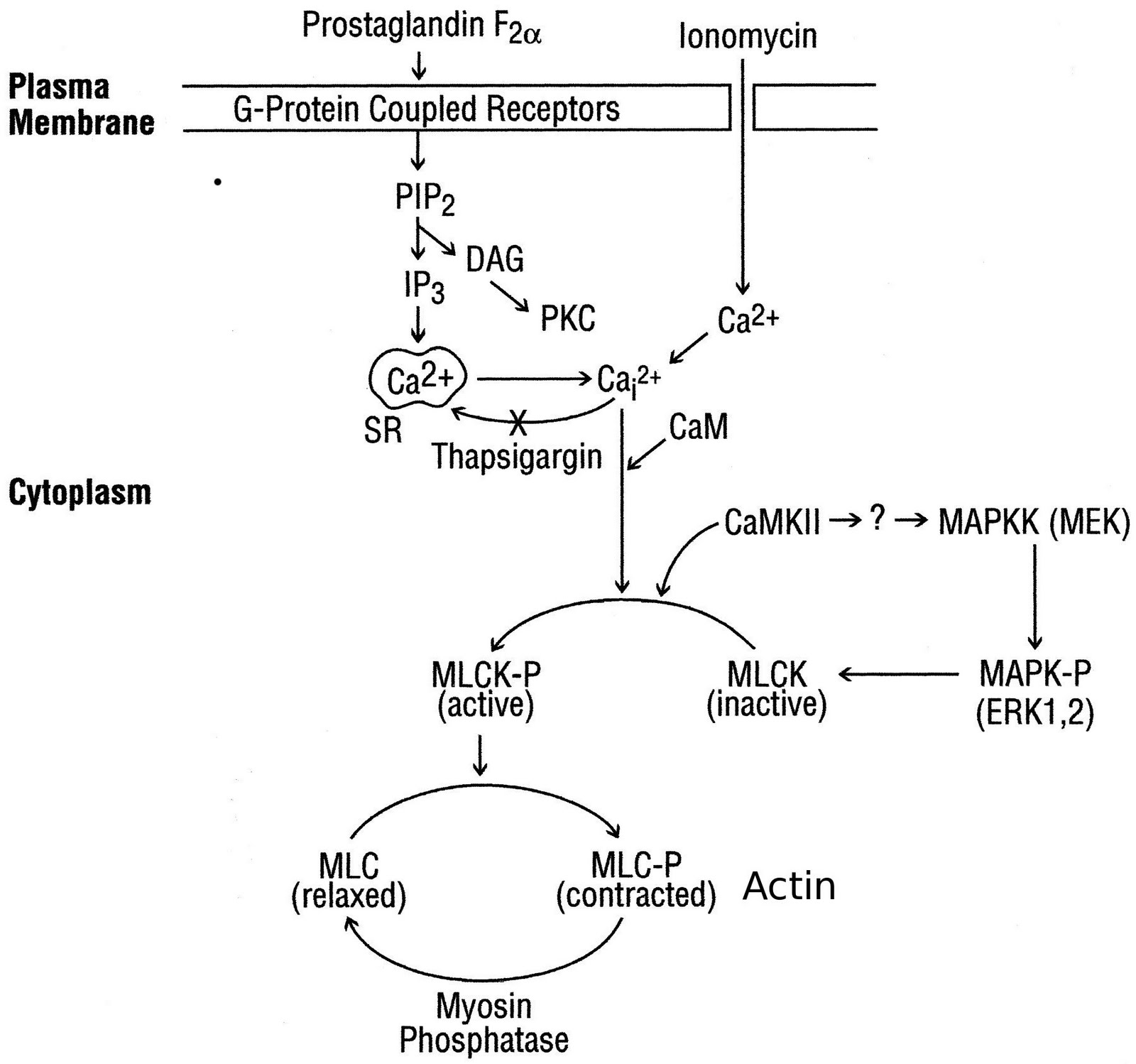
       Iris sphincter muscle cells express M3 receptor on their surface which is linked with pertussis toxin-insensitive G protein Gq/11, resulting in hydrolysis of membrane phospholipids; subsequent activation of phospholipase C-b (PLC-b) generates the major second messengers inositol (1,4,5)-trisphosphate (IP3) and diacylglycerol (DAG). Inositol(1,4,5)-trisphosphate binding to its receptor on intracellular storage sites results in mobilization/increasing cytosolic Ca2+ from extra cellular source and/or golgi bodies. Then Ca++ becomes available into the sarcoplasm and binds to troponin molecules in the thin filaments causing the troponoin to change the shape. This change in shape releases the troponin-tropomyosin complex from the myosin binding sites on the action. Contraction power strokes use ATP; myosin heads bind to actin, swivel and release; thin filaments are pulled toward center of sarcomere and finally contraction of the muscle. The increased Ca2+ in cytosol activates different mechanism/pathways; in which it actives rapid phosphorylation and activates of p42/p44 mitogen-activated Protein Kinase (MAPK), Ca2+/calmodulin-dependent protein kinase II (CaMKII) and myosin light chain kinase (MLCK), and other signaling cascade activating other enzymes as well as phosphorylation of myosin light chain (MLC) phosphorylation and contraction. 
      The miotic and mydriatic effect also found by nonadrenergic, noncholinergic response of the iris has been found in recent years in neurotransmitter binding site e.g., neurokinin A and B (NKA, NKB) which influx Ca2+ but not through the voltage-dependent channels, which are opened on depolarization of the membrane, mainly through the L and N types.
      The Ca2+ channels and the signalling pathways activated by ET-1 in the isolated rabbit iris sphincter. A scheme showing the signalling pathway activated by ET-1 to elevate [Ca2+]i and induce contraction is given below: We show that contraction of the iris sphincter by ET-1 or carbachol depends on the influx of extracellular Ca2+, as shown by abolition of the contraction after removal of extracellular Ca2+ nifedipine had minimal effects on the ET-1-induced functional responses. This latter observation is interesting because in cat iris sphincter, the Ca2+ mobilizing agonists PGF, ionomycin and thapsigargin increased MAP kinase phosphorylation and contraction.
      In the eye, the activation of EP1, EP4, and FP receptors by their selective agonists reduces intraocular pressure and causes pupil constriction.

Wednesday, March 26, 2008

Criteria for a Good Primer

By Bishnu Marasini
1. Primer Length:  It is important because melting temperature (Tm) and specificity partially relevant to primer length. Too long primer is inappropriate due to Tm and secondary structure formation and too short primer may not be specific. Generally 15-30 base long primer (or pair) is suitable.
2. Melting temperature (Tm): Tm of both primers (right and left primers that form a pair) is important while setting the annealing temperature in PCR reaction. Annealing temperature is usually set at 5°C less than the lower Tm (among the Tm of both primers). Generally the difference in Tm of both the primers also can’t be more than 5°C.
We can calculate the arbitrary Tm given by Wallace's rule for short length primer;
Tm = 4(G+C) + 2(A+T)°C
It should be around optimum Tm of template dsDNA and shouldn’t be deviate by more than 5°C.
3. %GC content: Although some genomic sequence have comparatively low GC content, around 50% GC content considered as suitable primer.
4. Self Annealing (SA): Self annealing of primer (forming like hair pin) make unavailable to anneal to template DNA. It can be scored as 1 (for each A-T pair) and 2 (for each G-C pair) when it forms the firmest hairpin structure and this score should be less than 20.
5. Pair Annealing (PA): Same as above (no. 4) when pair of primer anneals each other and it also should be less than 20.
6. Best Primer-pair Selection (total score of all of the above parameter): The final score of primer (or pair of primer) is calculated considering above mentioned parameter and best primer (or pair of primer) has the lowest value and always should be less than 10
score 1 per 10% difference in the optimal GC %
score 1 per °C difference from the optimal Tm
score 1 per 10 units of self annealing
score 1 per 10 units of pair annealing

NCBI’s online software “primer 3” for primer design (http://www.ncbi.nlm.nih.gov/tools/primer-blast/)

Wednesday, May 23, 2007

Involvement of protein kinase C- in DNA damage-induced apoptosis

Caspases are essential for the execution of cell death by apoptotic stimuli.1,2,3,4 The pathway of cell death varies depending on the cell type as well as the apoptotic stimuli. It is generally believed that binding of Fas ligand or tumor necrosis factor- (TNF) to their receptors causes activation of the initiator caspase-8 followed by the activation of a caspase cascade to execute cell death.2,5 In contrast, DNA damaging agents are known to induce release of mitochondrial Cytochrome c, which facilitates the interaction of apoptotic protease activating factor (Apaf-1) with procaspase-9 to initiate the activation of downstream effector caspases, such as caspases-3 or -7 to cause cell death.3 Both receptor-mediated and anticancer drug-induced apoptosis may, however, involve more than one pathway and there may be cross-talk between these two pathways.6,7,8

cis-Diamminedichloroplatinum(II) (cDDP or cisplatin) is one of the most important anticancer agents used for the treatment of solid tumors.9 Although the antitumor activity of cDDP is believed to be due to its interaction with chromosomal DNA, only a small fraction of cDDP actually interacts with DNA and inhibition of DNA replication cannot solely account for its biological activity.10 The efficacy of chemotherapeutic drugs not only depends on their ability to induce DNA damage but also on the cell's ability to detect and respond to DNA damage.11 cDDP, like other chemotherapeutic drugs, causes activation of caspases although the sequence of events that follow cDDP-induced DNA damage and lead to apoptosis remains to be unraveled.

We and others have shown that the PKC signal transduction pathway regulates cell death by cDDP.12,13,14,15,16,17 PKC is a family of 11 isozymes that are classified as the conventional PKCs (, I, II and ), novel PKCs (, , , and ), atypical PKCs ( and / ) and novel/atypical PKC.18 PKC is a substrate for caspase-3 and the catalytic fragment of PKC has been directly associated with apoptotic cell death.19,20 We have, however, demonstrated that downregulation of PKC that decreased the abundance of PKC catalytic fragment was associated with increased cellular sensitivity to cDDP.17 These results raise the possibility that PKC acts upstream of caspases to regulate cell death by cDDP. It is not known which PKC isozyme regulates activation of caspases and which step(s) of the cisplatin-induced cell death pathway is regulated by PKC.

Mitochondria play a pivotal role in the decision making process of a cell's life and death.21 It is believed that once Cytochrome c is released from mitochondria, cells are committed to die.22 An inability to induce release of Cytochrome c from mitochondria has been associated with cellular resistance to anticancer agents, including cDDP.23 In the present study, we have investigated how PKC regulates release of Cytochrome c and activation of caspases that emanate from mitochondria. Our results show that in HeLa cells, PKC was localized not only in the cytosol but also in the mitochondrial fraction and cDDP induced processing of both cytosolic and membrane-associated PKC. Rottlerin, a specific inhibitor of PKC, blocked cDDP-induced activation of caspases and proteolytic cleavage of PKC in both cytosolic and HM fractions but inhibited only late but not early release of Cytochrome c. Furthermore, inhibition of nPKC, but not of cPKCs, protected cells against cDDP-induced cell death. Taken together, these results demonstrate that PKC influences cDDP-induced cell death by acting at an early step of the mitochondrial cell death pathway that precedes activation of caspases.

Friday, May 04, 2007

Camphor

Description
The camphor tree is a dense broadleaved evergreen that is capable of growing 50-150 ft (15.2-45.7 m) tall and spreading twice that wide with a trunk up to 15 ft (4.6 m) in diameter, though the largest U.S. specimens are only half that size and those in the Caribbean are even smaller. The shiny foliage is made up of alternate 1-4 in (2.5-10.2 cm) oval leaves dangling from long petioles. Each leaf has three distinct yellowish veins. The outer margins of the leaves tend to be somewhat wavy and turn upward. The new foliage starts out a rusty burgundy color, but the leaves soon turn dark green on the upper sides and paler green underneath. New branches emerging from the shallowly fissured grayish brown trunk are smooth and green. Twigs are usually green, but may be tinged with red when young. The inconspicuous tiny cream colored flowers are borne in the spring on branching 3 in (7.6 cm) flower stalks. They are followed by large crops of fruit, comprised of round pea sized berries attached to the branchlets by cuplike little green cones. The berries first turn reddish, then ripen to black. Camphor tree can be readily identified by the distinctive odor of a crushed leaf.


This camphor tree shades a house in North Florida - a landscape use no longer considered appropriate for this invasive species.
Location
Cinnamomum camphora, the camphor tree, comes from China, Japan, Korea, Taiwan, and adjacent parts of East Asia, where it grows in mesic forests and on well-drained sites along streambanks. Camphor has become widely naturalized in Australia. In the United States, it is grown along the Gulf Coast and in California, and has escaped cultivation and become naturalized in many areas.

Culture
Camphor prefers fertile sandy soil. It will tolerate a pH anywhere in the range of 4.3 to 8. The roots are very sensitive to disturbance. They may extend far from the trunk of the tree, and can readily be identified by their characteristic odor.
Light: Camphor will grow in full sun or partial shade.
Moisture: Camphor tree does not do well in wet soils. Established trees are tolerant of drought.
Hardiness: USDA Zones 8 - 10. Hardened off camphor trees can survive freezes down to 10-15ºF (-12 - -9ºC), but new growth will suffer freeze burn when the temperature drops below 32ºF (0ºC) and branches will die back from temperatures in the low twenties.
Propagation: Camphor seed does not remain viable for long and should be planted in the greenhouse as soon as it ripens. Remove the fruit pulp first. At 68ºF (20ºC), germination will take 1-6 months. Cuttings of semiripe side shoots can be rooted in a warm humid place in midsummer. Pieces 2-3 in (5.1-7.6 cm) long with a heel work best.

Usage
Camphor is widely planted as a shade tree, screen, or windbreak. In China and Japan, it is grown commercially for its medicinal oil. Camphor oil has a strong penetrating fragrance, a pungent bitter flavor, and feels cool on the skin like menthol, though it also has irritating qualities as well as a numbing effect. Camphor has been used to treat ailments ranging from parasitic infections to toothaches. Scientific evidence has confirmed that chemicals in the plant have value in antiseptics and medications for treating diarrhea, inflammation, itching, and nervous conditions. Camphor wood is prized for its attractive red and yellow striping, amenability to woodworking, and insect repelling properties. It is light to medium in weight and soft to medium in hardness. Wood from the camphor tree is not especially strong, but it takes polishing well. It is commonly used for chests, closets, coffins, instruments, and sculptures. Camphor veneer is used in fine cabinetry. Camphor is also used in perfumes.


camphor tree trunk and bark
Features
This is a sturdy storm resistant tree which makes a good windbreak. Since it is hard to burn, it should also be valuable as a shade tree in areas that are prone to wildfires. Unfortunately, these desirable traits are offset by the tree's invasiveness and damaging effects on wildlife and natural communities. This fine tree should be grown and appreciated in its native range, but not planted in other regions where species and ecosystems have not adapted to its aggressiveness and toxicity. Camphor tree should not be grown in the United States.

WARNING
Camphor in large doses is toxic to humans. It stimulates the central nervous system and may affect respiration or cause convulsions. In Chinese medicine, camphor is forbidden for pregnant women and those with a deficiency of vital energy or yin. Camphor is a prolific seed producer that apparently does not have serious predators or diseases outside its native range. Seedlings and root sprouts are abundant near mature trees, but individual trees pop up far from seed sources. In Florida, camphor trees appear in undisturbed mesic hardwood forests, upland pine woods, and scrubs, as well as in the vacant lots and fencerows where it is more commonly observed. The Plant Conservation Alliance lists this species as an Alien Invader and it is listed as a Category I invasive exotic species by the Florida Exotic Pest Plant Council, which means that it is known to be "invading and disrupting native plant communities in Florida

Thursday, January 06, 2005

How shigella causes dysentery

French scientists say they believe they’ve discovered how shigella bacteria survive in the gut to be able to cause dysentery.
Laurence Arbibe and colleagues at the Pasteur Institute in Paris found a protein produced by shigella is injected into host cells and blocks production of immune signals required for preventing the infection.
Shigella affects millions of people worldwide, killing hundreds of thousands annually.
The researchers studied Shigella flexneri infection of human colon cells to understand the bacterial factors required to initiate disease. Shigella bacteria are known to inject up to 20 proteins into intestinal cells for the purpose of promoting infection and for dampening immune responses.
They found one of the injected proteins, OpsF, could prevent gut cells from switching on genes involved in immune responses. As a consequence, Shigella flexneri avoids being killed by their host’s immune cells and is able to spread throughout the gut.
The scientists say their study highlights the precision with which pathogens such as shigella can dramatically alter host cells. It also suggests blocking OspF may provide a target for treating bacterial dysentery.
The study is reported in the January issue of the journal Nature Immunology.

How Can Rhinos be Saved? Save the Rhino.

Love Animals and Save Rhinoceros (Gainda; गैंडा)
I have never supported the killing of animals for any purpose. Also, decreasing numbers of endangered rhinoceros by poachers who are protected under politicians and mafias is the subject of anxious for me in these days. Because of exaggeration, people are usually confused with the horn of the rhino has the medicinal value or other magic power. But no such kind of this thing is associated with the horn. In fact, this is only compact keratin as same as our hair.

How cruelty can poacher show for this useless horn just for a little money.
Unfortunately, they are unwilling to know, the more money they can earn by saving these rhinos and pursuing tourism or after the natural death of the animal.

Nepal has the prestige of being longest history as well as power. But her prestige has been declining for a few centuries and still not even in stationary phage. Government of Nepal has not been focusing to develop science and technology for revenue generation and to make a better life of Nepalese, what a pain! Tourism as a little hopes and is one of the major revenue generating sectors. The national park is one of the major destinations for tourists. It could be broadened and managed well for more income. One horned rhinos (Rhinoceros unicornis) are only found in Nepal and India as their natural habitat. Nepal has gifted a pair of rhino to Pakistan, where it is extinct. Caring and saving of rhinoceros, tiger and other many endangered animals found in Nepal help not only to attract tourists but also to preserve our biodiversity. I think the rate of killing of such endangered animals can be retarded by a combination of the following strategies.


  • Awaking the locals about the environment and wildlife because local people also have been found to be involved in killing or stealing of the horns of Rhinos in some cases. Also, they can co-operate with security personnel to handcuff the poachers.
  • Installing the secret cameras at least the place where rhinos defecate. Rhinos prefer to defecate in a single place. The heap of dung can guide poacher to trap and kill the rhinos.
  • Establishing the security post especially in the border side because poachers are abusing some flexible rules and facilities of both countries.
  • Although there is fine but it should be more strict.
  • If you have any idea, please share.

    ( Just published in a Newspaper, 2005, This article is an unedited version)